Quick Answer: The right PVC stabilizer depends on your application, processing temperature, regulatory requirements, and end-use environment. For most manufacturers in India, Calcium-Zinc stabilizers work best for lead-free compliance. Lead stabilizers suit high-volume pipe and cable production. Always match the stabilizer to your specific process and product requirement.
Introduction
If you choose an incorrect PVC stabilizer, then you might find yourself throwing away an entire batch. Fading colors, premature degradation of products, and complaints from customers follow as a consequence. Such situations occur much more frequently than anyone thinks, and in the vast majority of cases, all because of one wrong decision at the procurement stage.
Selecting the right PVC stabilizer is not a difficult task – but it requires a lot of thinking. You should know about the nature of your application, your processing conditions, and requirements for the final product. Everything you need to know in order to select the right PVC stabilizer is included in this guide. Let’s begin!
What Is a PVC Stabilizer?
A PVC stabilizer is a chemical that preserves PVC in cases of its high-temperature treatment such as extrusion, calendering, and injection molding. It preserves its stability, color, and properties. Without it, your PVC compound will not withstand the heat of the manufacturing process at all.
The functions of PVC stabilizers include the following:
- Protection from degradation due to high temperatures of the manufacturing process
- Prevention of discoloration and yellowing both during the process of manufacturing and afterward
- Prevention of emission of dangerous hydrogen chloride gas during the manufacturing process
- Increasing the lifetime and durability of the finished PVC product
- Preservation of the mechanical strength and flexibility of the PVC product
- Improvement of the efficiency of processing the PVC material
Why Choosing the Right PVC Stabilizer Matters
Your choice of stabilizer will determine everything – the quality of your product, the efficiency of your manufacturing process, and even whether or not you can sell in particular markets. Here are some reasons why this choice is so important.
- Product quality depends on it - An inappropriate stabilizer will make your finished product become discolored, brittle, and have poor surface finish.
- It affects your processing speed - Some stabilizers work better when processing at higher speeds. If you choose incorrectly, this will slow you down.
- Regulatory compliance is at stake - Many export markets ban lead-based stabilizers. Choosing wrong can block you from selling internationally.
- It directly impacts your costs - Using more stabilizer than needed increases your formulation cost without adding any real benefit.
- End-product life depends on it - A poorly stabilized PVC product degrades faster - meaning more returns, more complaints, and more losses.
- It affects your workers and environment - Some stabilizers release harmful substances during processing. Choosing safer options protects your team and your facility.
- Customer trust is built on consistency - When your product quality stays consistent batch after batch, your clients stay loyal. That only happens with the right stabilizer.
Getting this decision right from the start saves you from a lot of expensive problems down the line.
Understanding the Different Types of PVC Stabilizers
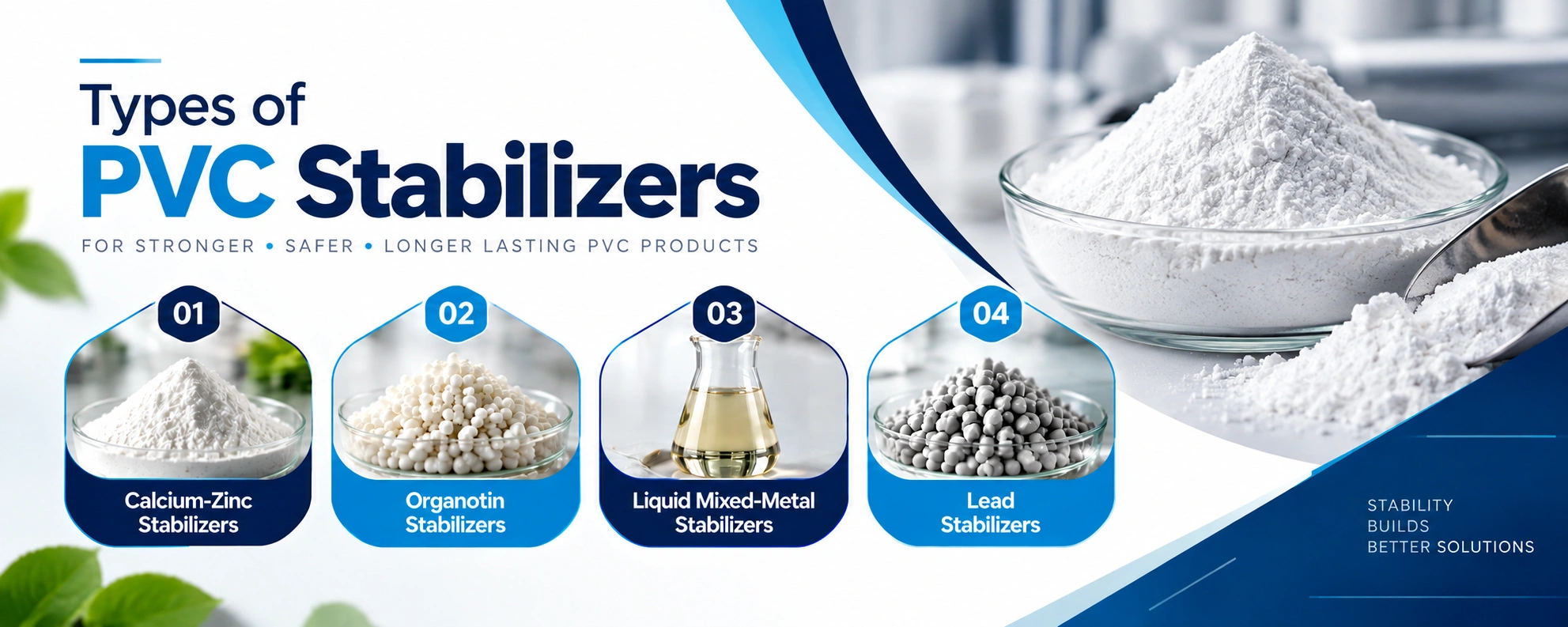
Not all PVC stabilizers are the same. Each type has its own strengths, limitations, and ideal use cases. If you want a deeper technical breakdown, check out our complete guide on different types of PVC stabilizers. Understanding the difference helps you make a smarter choice for your specific production needs.
1. Calcium-Zinc Stabilizers
Calcium-Zinc stabilizers are the most popular lead-free option available today. They are safe, compliant with REACH and RoHS regulations, and work well across a wide range of PVC applications including pipes, films, cables, and footwear. If you are exporting to Europe, GCC, or ASEAN markets - Ca-Zn is the right choice. They offer good thermal stability, clean color, and excellent regulatory acceptance worldwide.
2. Organotin Stabilizers
Organotin stabilizers offer very high thermal stability and excellent clarity - making them ideal for rigid PVC applications like transparent films, bottles, and profiles. They perform well at high processing temperatures and give a very clean, clear finish to the final product. However, they are more expensive than other stabilizer types and require careful handling due to regulatory restrictions in certain regions and applications.
3. Liquid Mixed-Metal Stabilizers
Liquid mixed-metal stabilizers are commonly used in flexible PVC applications like cables, artificial leather, and soft films. They are easy to handle, blend well into the formulation, and offer good heat stability for medium-temperature processing. Their liquid form makes dosing easier and more consistent on the production line. They are a practical choice when you need flexibility in both the product and the process.
4. Lead Stabilizers
Lead stabilizers have been used in PVC manufacturing for decades - and for good reason. They offer excellent thermal stability, long-term durability, and outstanding electrical insulation properties. They are widely used in pipe extrusion and wire and cable manufacturing in India and other markets where lead restrictions do not apply. However, they are being phased out in many international markets due to health and environmental regulations. Always check your target market requirements before choosing lead-based systems. For a side-by-side breakdown, see our comparison of Calcium-Zinc vs. Lead-Based Stabilizers.
Each stabilizer type serves a different purpose. The best one for you depends entirely on what you are making, where you are selling, and what regulations you need to follow.
7 Factors to Consider When Choosing a PVC Stabilizer
Choosing a stabilizer is not just about picking a product from a catalogue. There are several important factors that directly affect how well the stabilizer performs in your specific process. Here is what you need to evaluate carefully.
1. Identify Your PVC Application
The very first question you need to ask is - what am I making? A PVC pipe stabilizer and a PVC footwear stabilizer are completely different products. The application defines everything - the type of stabilizer, the loading level, and the performance requirements.
For example:
- Rigid PVC pipes need stabilizers with high heat resistance and long-term durability
- Flexible cables need stabilizers that maintain electrical insulation and flexibility
- PVC footwear needs stabilizers that support good color development and fast processing
- Transparent films need stabilizers that give crystal clear output without yellowing
Always start with your application. Everything else follows from there.
2. Consider the Processing Method
How you process PVC matters just as much as what you are making. Different processing methods create different heat and shear conditions - and your stabilizer needs to handle those conditions properly.
Extrusion, calendering, injection molding, and compression molding all put different levels of stress on the PVC compound. A stabilizer that works perfectly in a calendering line may not give the same results in a high-speed extrusion setup. Always check the processing temperature range, residence time in the equipment, and shear conditions before finalizing your stabilizer choice.
3. Evaluate Thermal Stability
Thermal stability is the core function of any PVC stabilizer. It tells you how well the stabilizer can protect PVC from heat degradation during processing. If your stabilizer does not have enough thermal stability for your processing temperature - your material will start discoloring, degrading, and losing mechanical properties.
Key things to check:
- Static thermal stability - how long the stabilizer protects at a fixed temperature
- Dynamic thermal stability - how it performs under actual processing conditions with heat and shear together
- Processing temperature range - make sure the stabilizer is rated for your line temperature
Always ask your supplier for thermal stability test data before making a decision.
4. Check Color Requirements
Color is one of the first things your customer notices. If your PVC product comes out with a yellowish tint, uneven shade, or faded color - it gets rejected. The stabilizer you choose plays a major role in the initial color and long-term color stability of your product.
Some stabilizers have a slight color contribution of their own. Calcium-Zinc stabilizers, for example, can sometimes cause early yellowing if not properly formulated. Organotin stabilizers give excellent initial color and clarity. If color accuracy is critical to your product - test the stabilizer thoroughly before running full production batches.
5. Assess Weather and UV Resistance
If your PVC product is going to be used outdoors - pipes, window profiles, roofing sheets, garden furniture - then weather and UV resistance becomes a critical requirement. Sun exposure, rain, and temperature changes can degrade PVC quickly if the stabilizer system is not designed for outdoor use.
In such cases, you may need to combine your stabilizer with UV absorbers or light stabilizers for complete protection. Always tell your stabilizer supplier about the end-use environment so they can recommend the right additive combination for your specific outdoor application.
6. Consider Compatibility With the Complete Formulation
A PVC compound is never just PVC and a stabilizer. Your formulation likely includes plasticizers, fillers like calcium carbonate, lubricants, pigments, impact modifiers, and other additives. Your stabilizer needs to work well with every single one of these components.
Compatibility issues can cause:
- Poor dispersion of the stabilizer in the compound
- Reactions between additives that reduce performance
- Surface defects like plate-out or blooming on the final product
Always run compatibility trials with your complete formulation - not just with virgin PVC. What works in a simple lab test may behave very differently in a real production compound with high filler loading.
7. Review Regulatory and End-Use Requirements
This is one factor that many manufacturers overlook - until it becomes a serious problem. Different markets and different end-use applications have very different regulatory requirements for PVC stabilizers.
For example:
- European Union - REACH and RoHS regulations restrict lead and certain heavy metals in PVC products
- GCC and ASEAN markets - are increasingly requiring lead-free stabilizer systems
- Food contact and medical applications - require specially approved stabilizer grades
- Children's toys and products - have very strict restrictions on harmful substances
If you are exporting or planning to export, always verify the regulatory requirements of your target market before choosing a stabilizer system. Switching stabilizers after production has already started is expensive and time-consuming.
When you evaluate all seven factors carefully, you will find that the right stabilizer becomes very clear. There is no single best stabilizer - only the best one for your specific situation.
Conclusion
Choosing the right PVC stabilizer is not a small decision. It affects your product quality, your production efficiency, your regulatory compliance, and ultimately your reputation with your customers. The good news is - when you understand your application, your process, and your market requirements clearly, the right choice becomes much easier to make.
If you are unsure where to start, work with a stabilizer manufacturer who understands your specific production needs - not just one who sells you a standard product off the shelf. At ALA Polystabs, we have been helping PVC manufacturers across India and international markets choose and formulate the right stabilizer systems for over 25 years. Whether you need Ca-Zn lead-free systems, one pack solutions, or custom formulations - our technical team is ready to help you get it right from the first batch.
Frequently Asked Questions
Q1. What is the difference between Ca-Zn and lead stabilizers for PVC?
Calcium-Zinc stabilizers are lead-free, environmentally safe, and compliant with international regulations like REACH and RoHS - making them ideal for export markets. Lead stabilizers offer stronger thermal stability and are more cost-effective for domestic high-volume production like pipes and cables, but are restricted or banned in many international markets.
Q2. Can I use the same PVC stabilizer for both rigid and flexible PVC applications?
No - rigid and flexible PVC have very different processing temperatures, formulations, and performance requirements. A stabilizer designed for rigid pipe extrusion will not perform correctly in a flexible cable or film compound. Always use a stabilizer that is specifically formulated for your application type.
Q3. How do I know if my current PVC stabilizer is causing product yellowing?
Yellowing during or after processing is usually a sign of inadequate thermal stability, incorrect stabilizer loading, or a compatibility issue with other formulation ingredients. Run a static thermal stability test and check your processing temperature against the stabilizer's rated range. Consult your stabilizer supplier with your full formulation details for a proper diagnosis.
Q4. Which PVC stabilizer is best for manufacturers exporting to Europe or GCC markets?
Calcium-Zinc stabilizers are the best choice for export to Europe and GCC markets. They are fully REACH and RoHS compliant, lead-free, and widely accepted across all major regulated markets. Lead-based systems are restricted in these regions and should be avoided entirely for export production.
Q5. Should I choose a one pack stabilizer system or individual components for my PVC formulation?
One pack stabilizer systems are pre-blended combinations of stabilizers, lubricants, and processing aids - designed for specific applications like pipes, cables, or footwear. They simplify your dosing process, reduce mixing errors, and ensure consistent batch-to-batch quality. For high-volume production with a fixed formulation, one pack systems are almost always the more reliable and efficient choice.