Titanium Dioxide is one of the most mass-produced and consumed compounds globally; however, many people are unaware of the fact that they use it almost daily. From the brilliant white hues of paint to the shield that protects our skin in sunscreens and even making appearances in food items, this potent chemical is integral to various sectors.
Titanium Dioxide (TiO₂) is a natural oxide of titanium and has excellent brightness, very high opacity, and good UV resistance. These properties contribute to its importance in industry, cosmetics, pharmaceuticals, and other areas.
Titanium Dioxide is the white pigment often used in paints and coatings. And whether you’re just curious, a student, or a business owner, this article will give you a few key facts to keep in mind.
What is Titanium Dioxide?
Titanium Dioxide (TiO₂) is a naturally occurring compound of oxygen and titanium. This is because of its high brightness, contrast, and ability to reflect light, which also makes titanium dioxide one of the most popular pigments in the world.
In simple terms, Titanium Dioxide is a white powder that is added to products to make them look brighter, more opaque, and more durable.
Key Characteristics of Titanium Dioxide
- Looks like a powder of white dust (Titanium dioxide powder)
- Superior light-scattering properties
- Powerful UV protection (deflects the sun’s rays)
- Non-reactive and chemically stable
- Safe to use for most regulated uses
In fact, Titanium Dioxide is so useful and versatile that it can be found inside many household items, including paint, plastic, cosmetics, sunscreen, and even certain food products.
Why is Titanium Dioxide So Popular?
The main thing that drives its popularity is that it can give you:
- High brightness and whiteness
- Good coverage (opacity)
- Durability over time
- Protection from UV rays
It is this combination that makes it a must-have ingredient in so many applications, from building materials to personal care.
Chemical Properties of Titanium Dioxide (TiO₂)
Titanium Dioxide (TiO₂) is highly appreciated for its special chemical and physical properties, which make it very effective in many fields. Its stability, brilliance, and resistance to environmental elements are some of the important factors that make it so popular.
Basic Chemical Composition
- Chemical Formula: TiO₂
- Molecular Structure: Composed of one titanium atom and two oxygen atoms
- Crystal Forms: Rutile, Anatase, and Brookite (Rutile is the most stable and commonly used)
Key TiO₂ Chemical Properties
.webp "Benefits of Titanium Dioxide")
- High Refractive Index: Titanium Dioxide possesses a high refractive index in natural substances, which contributes to its high brightness and opacity.
- Good UV Stability: It is a UV radiation absorber and scatterer, which is why it is commonly used in sunscreens and protective films.
- Chemical Stability: TiO₂ is very stable, and it does not easily react with other chemicals under extreme conditions.
- Non-Toxic Under Controlled Use: It is widely regarded as a safe ingredient in cosmetics, paints, and pharmaceuticals when applied within the boundaries of the regulations.
- Photocatalytic Activity (Anatase form): This enables the material to degrade organics under illumination, which is exploited in environmental and self-cleaning applications.
Top Titanium Dioxide Uses Across Industries
Titanium dioxide (TiO2) is the most widely used white pigment and has a variety of applications due to its brightness, high opacity, and protective nature. Its enhancement of appearance and durability are the reasons it is needed in so many industries.
1. The Paints and Coatings Industry
Titanium Dioxide is widely utilised in paints and coatings. It offers:
- Bright white colour and good opacity
- More coverage at fewer costs
- Resistance to sunlight-induced fading
2. Plastics Industry
In plastics, titanium dioxide is used to:
- Enhance color and brightness
- Provide UV protection
- Extend the life of the product
3. Paper Industry
Titanium Dioxide Improves the Quality of Paper:
- Enhances whiteness and brightness
- Improves print clarity
- Increases the durability of paper
4. Food Industry
Titanium Dioxide is also used, in small amounts, as a food additive to:
- Add whiteness and help the visual appeal
- Contribute to the texture of products such as candy, chewing gum, and baked goods.
5. Pharmaceutical Industry
In the pharmaceutical grade, titanium dioxide is used as:
- A pharmaceutical coating agent for tablets and capsules
- A colorant to enhance identification
- A protective barrier to extend shelf life
6. Cosmetics and Personal Care
Titanium Dioxide has a major role in numerous personal care products, including:
- Sunscreens (UV protection) for the skin
- Face powders and foundations
- Toothpaste and skin care products
Titanium Dioxide Safety Concerns and Risks
Although Titanium Dioxide(TiO₂) is widely used and considered to be safe for application in many fields, it has also raised some safety issues, particularly in certain forms and under certain conditions of exposure. Awareness of these risks allows for informed use.
- Inhalation Hazards (Particularly Titanium Dioxide Powder)
The greatest worry is related to breathing in small particles of Titanium Dioxide powder:
- Chronic industrial exposure may lead to lung damage
- Considered a potential carcinogen when inhaled in significant quantities (organisations such as IARC)
- Factory workers need to wear protective gear at the very least, if not a full respirator.
- Issues with Food Products (E171)
Titanium dioxide has been used as a food additive (E171) to improve whiteness. However:
- Several studies were of concern about nanoparticles being absorbed into the body
- The European Union banned E171 in food as a precautionary measure
- It is still permitted in other countries, although within legal limits
- Issues of Safety of Nanoparticles
When Titanium Dioxide is applied in nano form:
- The particles are so small, though, that they may act differently in the body
- There is some apprehension that it builds up in the organs over time
- Investigations are still underway to be able to define the long-term effects
- Skin Safety in Cosmetics
For topical application (such as sunscreen and makeup):
- Titanium Dioxide is safe for use on undamaged skin
- It does not penetrate the skin barrier easily
- Non-nano forms of titanium dioxide are generally recognized as safe
- Environmental Impact
Production and disposal of titanium dioxide may be:
- Lead to pollution of the environment if allowed to run to waste
- Influence aquatic life at elevated levels
Benefits of Titanium Dioxide
Titanium Dioxide (TiO₂) is the workhorse of the performance materials sector; the performance, safety, and cost balance among these materials is difficult to match. Its special properties make it a necessary component in a myriad of products that we use day to day.
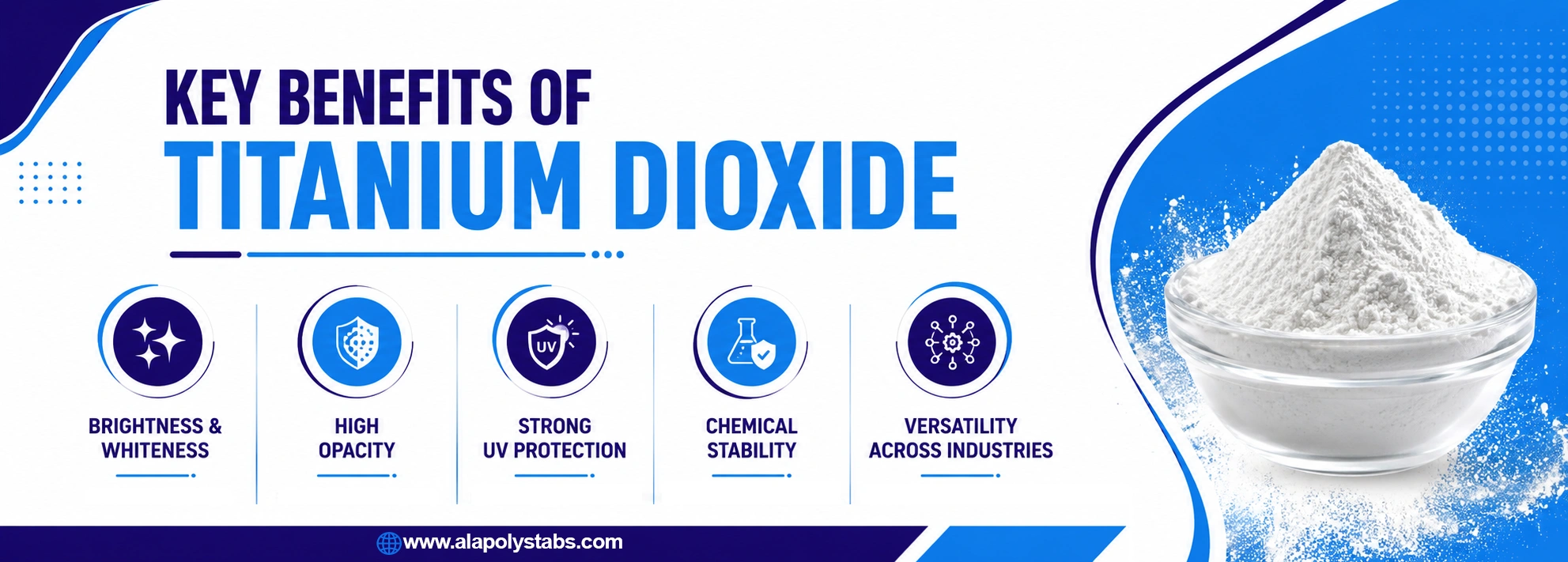
1. Exceptional Brightness and Whiteness
Titanium Dioxide (TiO₂) is renowned for its excellent brightness and clean white appearance and is the most efficient white pigment utilised internationally. Because it has a high refractive index, it is able to reflect light better than many other substances, resulting in a clean, bright, and appealing look for the products.
2. High Opacity (Excellent Coverage)
One of the defining attributes of Titanium Dioxide (TiO₂) is its incredible opacity, which enables it to obscure or cover surfaces underneath it. This enables goods to have a solid, consistent look even when a small amount of material is used.
3. Strong UV Protection
Titanium Dioxide (TiO₂) is so effective at deflecting and scattering the damaging ultraviolet (UV) light that it has become an indispensable protective ingredient in a wide range of products.
4. Chemical Stability and Durability
Titanium Dioxide (TiO₂) has a strong chemical inertness, i.e., it is not readily reactive with other materials even in extreme environmental conditions. It is therefore very reliable for long-term use in many fields of application.
5. Versatility Across Industries
Titanium Dioxide (TiO₂) is renowned for its exceptional versatility, being utilized in numerous industries thanks to its brightness and opacity combined with UV protection and enhanced stability.
Conclusion
Titanium Dioxide (TiO₂) remains an essential component in many industries because of its unique properties, including brightness, opacity, UV protection, and weathering stability. From paints and plastics to cosmetics and pharmaceuticals, its applicability is so broad that it is considered one of the most dependable and indispensable compounds in contemporary manufacturing.
However, the quality of Titanium Dioxide and corresponding specialty chemicals is totally dependent on the know-how and trustworthiness of the manufacturer. This is without doubt where ALA Polystabs Private Limited distinguishes itself as a reliable company in the line of business. Company Profile With quality, innovation, and customer satisfaction as the core values, the company specializes in producing, exporting, and supplying the best kinds of specialty chemicals.
The ALA Polystabs range is made from premium quality active ingredients obtained from certified vendors, and the manufacturing process adheres to rigorous international quality standards.
Frequently Asked Questions
1. What is Titanium Dioxide used for?
Titanium Dioxide is mainly used as a white pigment and UV-blocking agent. It is widely found in paints, coatings, plastics, cosmetics (like sunscreen and foundation), pharmaceuticals, and some food products to improve brightness, color, and durability.
2. Is Titanium Dioxide safe for humans?
Yes, Titanium dioxide is safe. It is allowed for use in cosmetics, medicines, and foods in most countries. Still, it is the inhalation of fine powder or exaggerated contact with some forms that give rise to safety issues.
3. Why is Titanium Dioxide used in sunscreen?
Titanium Dioxide is an active ingredient in many sunscreens because it has the ability to absorb and reflect UV radiation (UVA and UVB). It creates a barrier on the skin that acts as a shield to reduce the risk of sunburn, skin injury, and early skin aging from sun exposure.
4. Is Titanium Dioxide banned in food?
Titanium Dioxide (E171) has been banned in food in the European Union, as the long-term consumption may pose some safety risks. However, it remains permitted in certain other countries, such as the United States and India, subject to regulatory limits.
5. What are the risks of Titanium Dioxide powder?
The primary risk of Titanium Dioxide powder is inhalation, particularly in the workplace. Prolonged exposure to dust may also have an impact on the lungs. That is why it is very important to have the right safety precautions, including masks and ventilation, when handling.