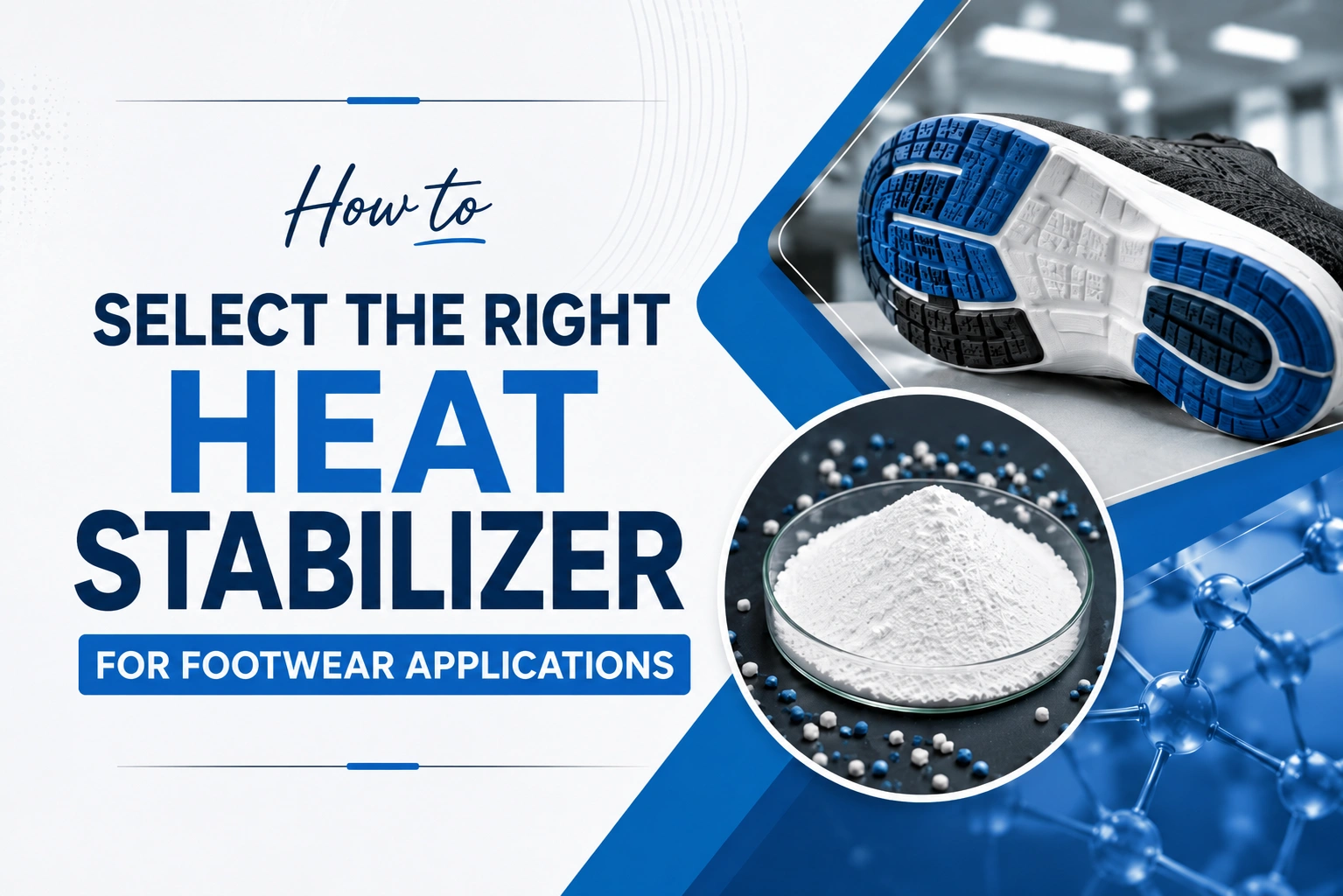
If you work in PVC footwear manufacturing, you already know how critical the right stabilizer is. One wrong choice and your entire production batch shows discolouration, surface defects, or premature degradation.
But here is the real problem — most manufacturers select a heat stabilizer based only on price or habit. Very few actually evaluate it based on their specific processing conditions, application requirements, and compliance needs.
That leads to poor product quality, material waste, and unexpected production downtime.
In this blog, we have covered everything you need to know before selecting a heat stabilizer for footwear applications — from key selection factors to common mistakes manufacturers make on the production floor.
Read this once and you will never make a wrong stabilizer choice again.
What is a Heat Stabilizer?
Heat stabilizers are chemical additives used in plastics and rubber — especially in PVC. Their job is simple — protect the material from breaking down when it is exposed to high temperatures during manufacturing processes like extrusion and moulding.
Without them, PVC loses its mechanical strength, changes colour, and degrades fast. This means weak products, failed quality checks, and wasted material on your production floor.
In short — heat stabilizers keep your PVC compound strong, stable, and processable from start to finish.
Importance of Heat Stabilizers in Footwear Applications
PVC footwear goes through intense processing conditions — high heat, heavy mechanical stress, and constant mixing. Without the right heat stabilizer, your compound starts degrading before it even reaches the mould.
The result is uneven colour, weak material, poor surface finish, and products that fail quality checks. On top of that, footwear needs to stay flexible, durable, and visually consistent across thousands of pairs. A good heat stabilizer makes all of this possible — batch after batch, without interruption on your production line.
Key Factors to Consider When Selecting a Heat Stabilizer
Selecting the right heat stabilizer is not guesswork. Every factor below directly affects your product quality and production efficiency. Evaluate each one carefully before making any decision.
Thermal Performance & Degradation Phase
Your stabilizer must match the exact temperature range of your processing line. If it loses effectiveness before your cycle completes, discolouration and degradation will follow. Always check the thermal stability window before finalising any stabilizer for footwear production.
Processing Method and Conditions
Different processing methods — extrusion, calendering, injection moulding — create different stress conditions on your PVC compound. A stabilizer that works well in calendering may underperform in extrusion. Always select a stabilizer specifically tested and recommended for your processing method.
Compatibility and Physical Properties
Your stabilizer must blend smoothly with your existing PVC compound, fillers, and other additives. Poor compatibility causes uneven dispersion, surface defects, and inconsistent colour across batches. Always test compatibility with your full formulation before running a full production batch.
Regulatory Compliance & Application Safety
If you supply footwear to global markets—especially the EU or the US—your stabilizer must comply with REACH, RoHS, and California Proposition 65. Lead-based stabilizers are now banned in the EU and highly restricted globally. Transitioning to non-toxic alternatives like Calcium-Zinc (Ca-Zn) is essential for modern compliance.
Synergy and Cost Efficiency
A good stabilizer works in synergy with co-stabilizers, lubricants, and other additives in your formulation. This synergy reduces the overall dosage needed — directly cutting your raw material cost. Never evaluate stabilizer cost in isolation — always calculate total formulation cost per kg of finished compound.
Types of Heat Stabilizers Used in Footwear Applications
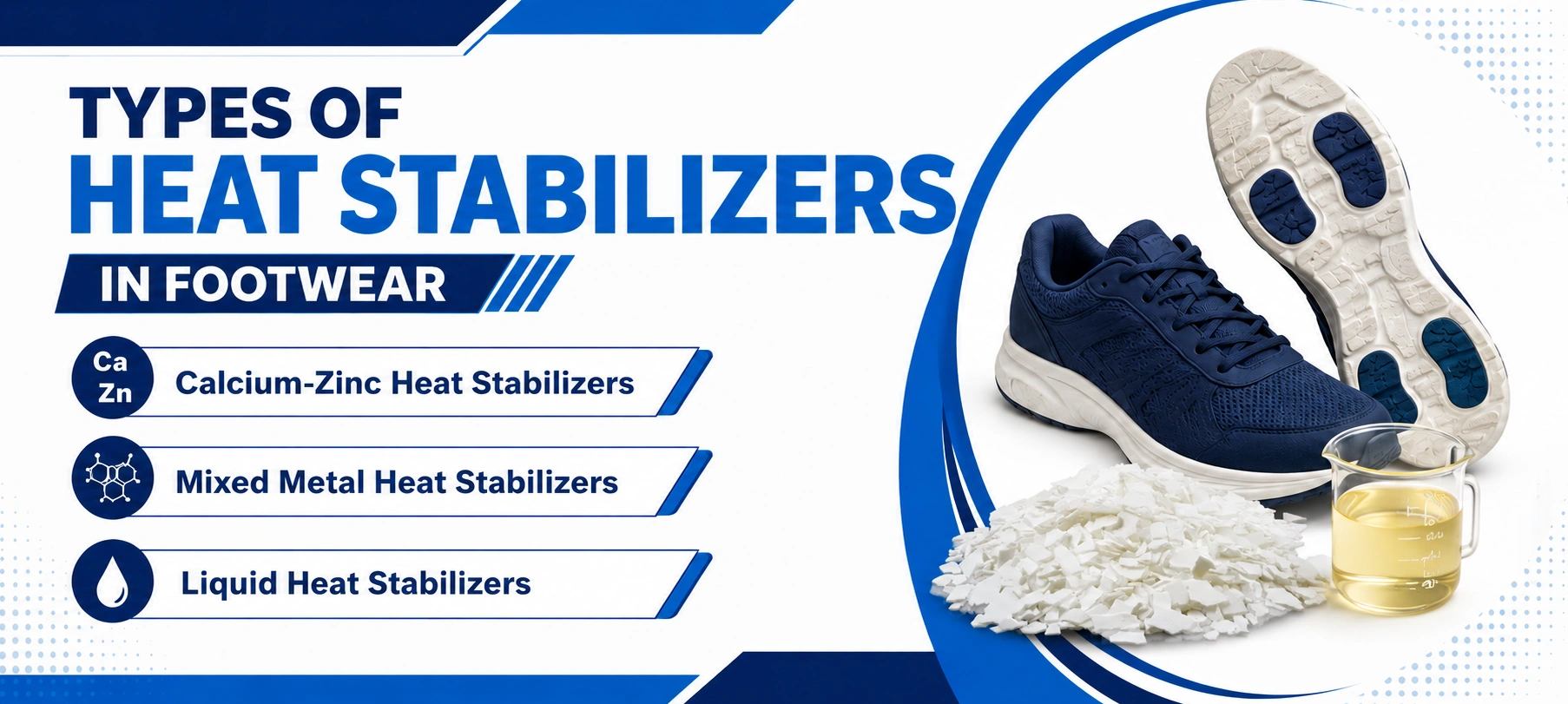
Footwear manufacturers use different types of heat stabilizers depending on the PVC formulation, processing method, and performance requirements of the final product. Selecting the right stabilizer helps ensure consistent processing, better product quality, and long-lasting durability.
Calcium-Zinc Heat Stabilizers
Calcium-Zinc Heat Stabilizers are among the most widely used options in the footwear industry because of their environmentally friendly composition, excellent thermal stability, and good processing performance. They are commonly used in flexible PVC footwear, including shoe soles, sandals, slippers, and other consumer footwear, where maintaining flexibility and appearance is essential.
Mixed Metal Heat Stabilizers
Mixed Metal Heat Stabilizers are designed to provide a balanced combination of processing efficiency, thermal stability, and mechanical performance. These stabilizers are often preferred by manufacturers involved in high-volume footwear production, as they help maintain consistent quality while supporting efficient manufacturing processes.
Liquid Heat Stabilizers
Liquid Heat Stabilizers offer excellent dispersion throughout flexible PVC compounds, ensuring a more uniform mixture during production. They are particularly suitable for applications where smooth processing, consistent color, and high-quality surface finish are important.
The best heat stabilizer ultimately depends on your footwear application, manufacturing process, processing temperature, and technical performance requirements. Evaluating these factors carefully will help you choose a stabilizer that delivers reliable processing, improved product quality, and long-term durability.
Common Problems Due to Wrong Stabilizer Selection
- Yellowing and discolouration in finished footwear during processing
- Uneven surface texture and rough finish on final products
- Loss of flexibility leading to cracks and high product rejection rates
- Poor batch to batch consistency and increased material wastage
- Machine fouling and unwanted deposits inside extruder or calendar machine
- Regulatory rejection in export markets due to restricted substances like lead
- Higher per kg production cost due to frequent rework and material waste
Conclusion
Selecting the right heat stabilizer for footwear applications is not a small decision. It directly affects your product quality, production efficiency, compliance, and ultimately your profit margins.
Many manufacturers discover this too late — when the batch is ruined, the machine is down, or the client has already complained.
The good news is — with the right knowledge and the right supplier, these problems are completely avoidable.
Evaluate your processing conditions carefully. Match your stabilizer to your specific footwear application. Prioritise compliance if you export. And always work with a supplier who understands your production floor — not just one who delivers a product.
If you are looking for a technically reliable stabilizer partner with 25 years of formulation experience, ALA Polystabs is ready to help.
Frequently Asked Questions
1. What is the best heat stabilizer for PVC footwear applications?
For PVC footwear, liquid or powder Ca-Zn stabilizers are the most recommended choice today. Manufacturers commonly use liquid Ba/Zn or Ca/Zn stabilizers to improve compatibility with plasticised PVC. They provide excellent flexibility, colour stability, and are safe for both workers and end users.
2. What is the difference between Ca-Zn and lead stabilizers for PVC footwear?
Modern Ca-Zn stabilizers offer thermal stability comparable to, and in many cases better than, lead stabilizers. They provide superior initial colour, excellent light resistance, and improved weatherability. Although lead stabilizers are less expensive, they are restricted in many export markets due to toxicity concerns.
3. At what temperature does PVC start degrading during footwear processing?
Ca-Zn stabilizer systems should effectively withstand processing temperatures between 160°C and 200°C. If the stabilizer loses effectiveness before processing is complete, the PVC can begin to degrade, resulting in yellowing, surface defects, and reduced product quality.
4. Why does my PVC footwear turn yellow during processing?
Yellowing occurs when the heat stabilizer cannot protect PVC at the processing temperature. Without proper stabilization, PVC undergoes dehydrochlorination, releasing hydrogen chloride (HCl) gas. This causes the material to change from yellow to brown and eventually black. Using the correct stabilizer formulation helps prevent this issue.
5. Do I need a lead-free stabilizer if I export PVC footwear from India?
Yes. Lead-free stabilizers comply with global and Indian regulations, including CPCB, MoEFCC, and RoHS requirements, making them suitable for international markets. If you export PVC footwear to the EU, GCC, or ASEAN countries, using lead-based stabilizers may lead to customs rejection of your shipment.