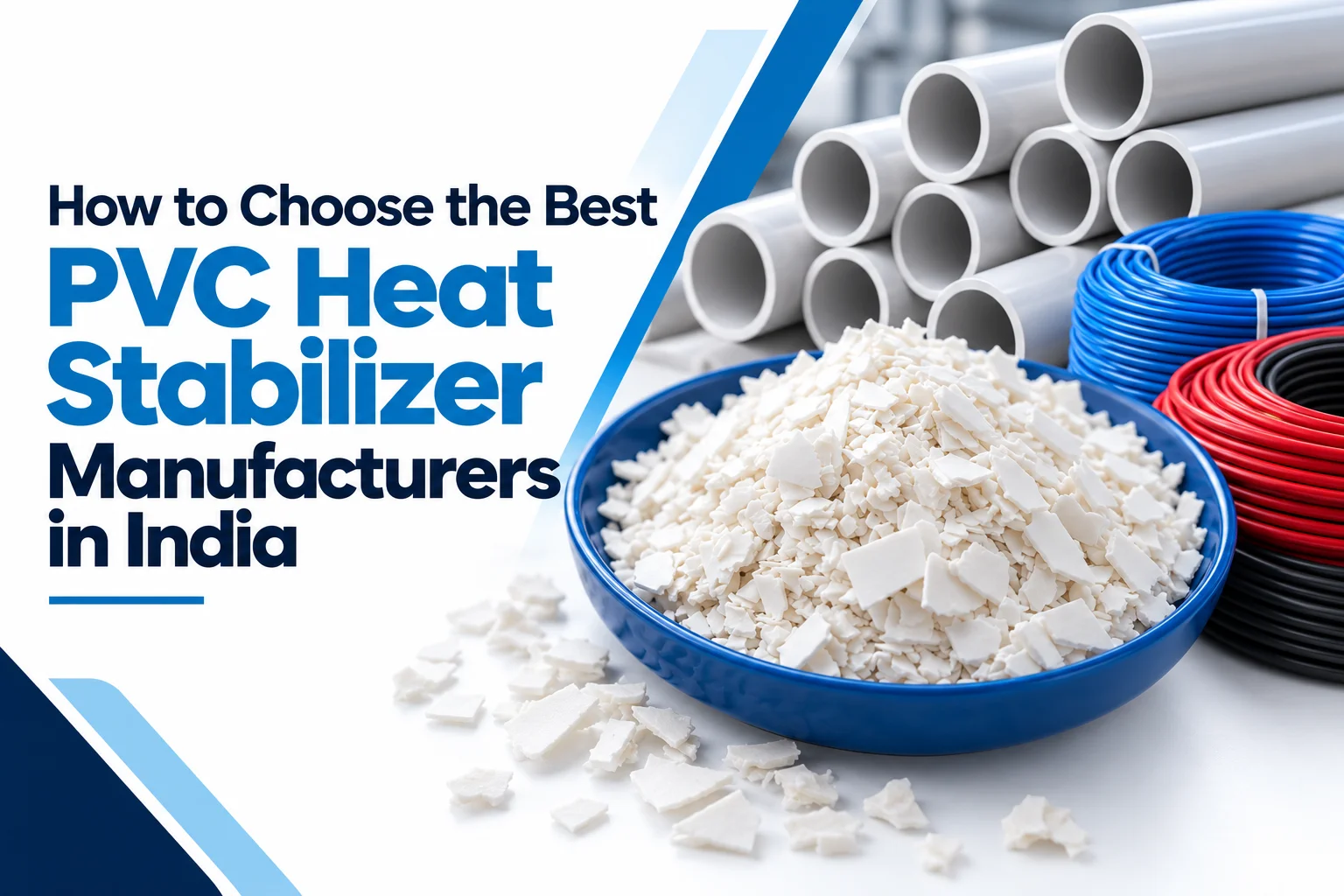
A stabilizer can look perfect on paper and still perform poorly on your extrusion line. That is why choosing among PVC heat stabilizer manufacturers in India should begin with your process, not a price list. The right supplier must understand your application, offer the chemistry you need, keep one batch consistent with the next and support trials before you scale up.
Compliance, lead time, dosage and technical response matter just as much as the quoted rate. This guide shows how to evaluate the best PVC heat stabilizer manufacturers without wasting time on claims that do not improve quality or reliability.
- What Should You Check Before Choosing PVC Heat Stabilizer Manufacturers in India?
- Does the Stabilizer Match Your PVC Application?
- Does the Manufacturer Offer the Chemistry You Need?
- Can the Manufacturer Keep Batch Quality Consistent?
- Does the Product Meet the Rules That Apply to Your End Use?
- Can the Manufacturer Help When Your Formula Needs Adjustment?
- Will the Manufacturer Let You Test Before You Commit?
- Can the Supplier Keep Your Production Line Supplied?
- Are You Comparing the Real Cost or Only the Rate Per Kilogram?
- What Are the Red Flags When Choosing PVC Stabilizer Suppliers?
- Choose PVC Heat Stabilizers from ALA Polystabs
- Conclusion
- Frequently Asked Questions
What Should You Check Before Choosing PVC Heat Stabilizer Manufacturers in India?
Start with one question: what does your PVC product need the stabilizer to do? A pipe manufacturer, cable compounder, profile extruder and footwear producer may all process PVC, but their formulations do not behave the same way. The stabilizer has to work inside your actual recipe and processing window.
That is why a supplier should be able to discuss more than the product name and explain how a pvc stabilizer works with your formulation, processing conditions and finished-product requirements. You should be able to talk about application, temperature, filler level, lubrication, colour, output and the finished product before anyone recommends a grade.
Does the Stabilizer Match Your PVC Application?
Do not begin by asking which grade is “best.” Ask which grade is suitable for what you manufacture. For example, a rigid PVC pipe formulation may need a different balance of thermal stability and lubrication than a flexible cable compound. Profiles may place more focus on colour and surface quality. Footwear compounds have their own processing needs.
ALA Polystabs currently lists PVC stabilizer solutions for pipes, cables, footwear, profiles, films and other PVC applications.
When speaking with PVC stabilizer manufacturers, share enough process detail for them to make a reasoned recommendation. A vague answer such as “this grade works for all PVC” should not be enough.
Does the Manufacturer Offer the Chemistry You Need?
The product range matters because not every application calls for the same stabilizer system. Understanding the differences between pvc and lead-free pvc can also help manufacturers select a formulation that meets their processing requirements and applicable market regulations. Depending on your process and market, you may be considering:
- Calcium-Zinc stabilizers
- One-pack stabilizer systems
- Lead-based grades where their use remains permitted
- Tin-based or other application-specific systems
- Lead-free formulations for restricted markets
ALA Polystabs lists Ca-Zn lead-free stabilizers, lead stabilizers, PVC heat stabilizers and one-pack systems in its current range.
A wider range helps only if the manufacturer can explain why one chemistry suits your requirements better than another. Product choice should come from processing needs, not from whichever grade happens to be in stock.
Can the Manufacturer Keep Batch Quality Consistent?
A trial batch that performs well is only useful if the next ten batches behave the same way. This is where quality control becomes important. Inconsistent stabilizer quality can show up as:
- Changes in initial colour
- Different heat stability
- Processing variation
- Surface defects
- Higher scrap
- Changes in output
- Unexpected adjustments in the formulation
Ask what the manufacturer controls from raw-material receipt to final dispatch. Where relevant, ask for technical data, batch documentation and a Certificate of Analysis.
For regular buyers, this is one of the biggest differences between dependable PVC heat stabilizer suppliers and sellers who compete mainly on price.
Does the Product Meet the Rules That Apply to Your End Use?
“Compliant” is too broad a word on its own. The right question is: compliant with what and for which application? Your requirements may depend on the finished product, customer specification, export market, heavy-metal limit or applicable Indian Standard.
India’s Lead Stabilizer in Polyvinyl Chloride Pipes and Fittings Rules, 2021 set lead-extraction limits for specified categories of PVC pipes and fittings. BIS guidance also refers to these requirements for relevant PVC pipe standards.
Export buyers may also need grades that meet requirements such as RoHS or REACH. ALA Polystabs states that its Ca-Zn lead-free range includes grades intended for markets with heavy-metal restrictions. Before approving any material, match the documentation to your real market and end use rather than relying on a general compliance claim.
Can the Manufacturer Help When Your Formula Needs Adjustment?
Some production problems cannot be solved by simply replacing one stabilizer with another at the same dosage. Suppose you raise filler loading, change resin, alter lubrication, increase processing speed or start seeing poor initial colour. In that case, the stabilizer system may need adjustment.
This is where technical support matters. The better PVC heat stabilizer manufacturers in India should be able to discuss your formulation and explain what may need to change. That support is especially useful when your process sits outside a standard recipe.
ALA Polystabs says its technical team develops custom formulations and one-pack systems based on processing conditions, filler loading and end-product needs. A useful supplier should help you solve a production problem, not simply send another price quote.
Will the Manufacturer Let You Test Before You Commit?
Do not judge a stabilizer only from a specification sheet. Better, run it first. A plant trial tells you far more about how the material will behave in your production conditions. During the trial, look at:
- Initial colour
- Thermal stability
- Fusion and processing behaviour
- Surface finish
- Output consistency
- Dosage
- Compatibility with your existing additives
If you are switching to a new PVC heat stabilizer supplier in India, avoid changing several parts of the formulation at the same time. Otherwise, it becomes difficult to know what caused an improvement or problem.
The trial should also use a realistic dosage. A cheap grade can become expensive if you need much more of it to achieve the same result.
Can the Supplier Keep Your Production Line Supplied?
Good performance means little if the material does not arrive when you need it. Check supply before you approve a manufacturer for regular business.
Ask about:
- Normal production lead time
- Minimum order quantity
- Standard pack size
- Repeat-order availability
- Capacity for larger orders
- Export documentation
- Dispatch and transport support
This matters most when your plant uses the same stabilizer every month. A reliable manufacturer should be able to give you a realistic lead time rather than an optimistic promise. A delayed additive can stop an entire production schedule. ALA Polystabs states that it manufactures in Greater Noida and supplies customers in India as well as export markets.
Are You Comparing the Real Cost or Only the Rate Per Kilogram?
This is where many buying decisions go wrong. The lowest quoted rate does not automatically mean the lowest production cost. Imagine two grades: One costs less per kilogram but needs a higher dosage and gives more colour variation.
The other costs slightly more but runs smoothly at a lower dosage and produces fewer rejects. The second grade may cost less by the time you calculate usable output. When comparing the Best PVC heat stabilizer manufacturers, look beyond the invoice rate. Compare:
- Cost at actual dosage
- Scrap and rejection
- Processing stability
- Machine adjustment
- Production speed
- Finished-product quality
- Technical support
- Supply reliability
That gives you a much more useful number than price per kilogram alone.
What Are the Red Flags When Choosing PVC Stabilizer Suppliers?
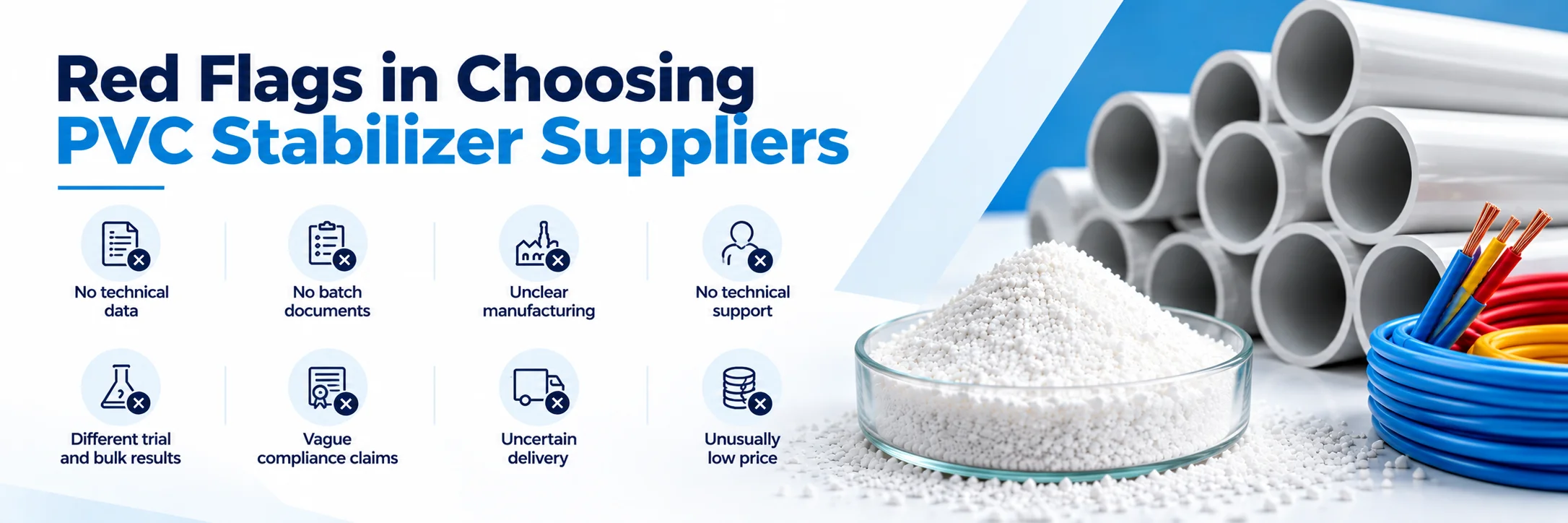
A poor supplier often reveals the problem before the first bulk order. Be cautious if the seller cannot explain where the product fits, avoids technical questions or promises that one grade will solve every PVC processing problem. Other warning signs include:
- No clear technical data
- No batch documentation when requested
- Unclear manufacturing source
- No one available to discuss formulation issues
- Large differences between trial and bulk material
- Vague claims about compliance
- Uncertain delivery commitments
- Pressure to order in bulk before a proper trial
Price can also be a warning sign. A surprisingly low quote deserves a technical explanation. Ask what chemistry you are buying, what dosage is expected and what performance you should reasonably expect.
The strongest PVC stabilizer suppliers do not need to hide behind generic claims. They can explain the grade, the use case, the documentation and the conditions in which the product is expected to perform. The goal is not to find the cheapest seller. It is to find a supplier that will still make sense after the fifth, tenth and twentieth order.
Choose PVC Heat Stabilizers from ALA Polystabs
ALA Polystabs offers PVC heat stabilizers, Ca-Zn systems, one-pack formulations, and technical guidance for diverse applications. Contact our team to find the right solution for your processing needs.
Enquire NowConclusion
Choosing a PVC stabilizer partner is really a production decision. The right manufacturer should understand your application, recommend suitable chemistry, maintain batch consistency, support testing, meet the required standards and deliver when promised.
Price still matters, but it should be measured against dosage, scrap, output and product quality. If a supplier performs well across those areas, you have more than a raw-material vendor. You have a technical partner who can support stable production over time.
Frequently Asked Questions
Q1. How do I identify the Best PVC heat stabilizer manufacturers?
Look at application fit, product range, batch consistency, technical support, compliance, plant-trial results, supply reliability and cost at the actual dosage you will use.
Q2. What should I ask PVC heat stabilizer suppliers before ordering?
Ask which grade suits your application, expected dosage, technical specifications, applicable compliance, lead time, MOQ, trial availability and what support they provide if processing problems appear.
Q3. Should I test material from PVC stabilizer manufacturers before buying in bulk?
Yes. A plant trial shows how the stabilizer behaves with your resin, fillers, additives, machine settings and processing temperature. That information is more useful than relying only on a data sheet.
Q4. Is there a difference between PVC stabilizer manufacturers and PVC stabilizer suppliers?
Yes. A manufacturer produces the material, while a supplier may manufacture it or source it elsewhere. Knowing the source can matter when you need technical support, traceability or consistent repeat supply.
Q5. Can a PVC heat stabilizer supplier in India develop a custom grade?
Some manufacturers can. Customisation may help when your formulation has unusual filler loading, processing conditions, colour targets, lubrication needs or end-use requirements that a standard grade does not address.